
Top 10 Types of Chemical Tanks for Industrial Use
Industrial chemical storage is not a one-tank decision. Chemical tanks differ by material, shape, lining, and containment design. Each choice affects chemical compatibility, temperature tolerance, cleaning, and maintenance. A polyethylene tank may suit some corrosive liquids, while stainless steel or lined steel may be better for other service conditions. Fiberglass-reinforced plastic, horizontal vessels, and double-wall designs bring different trade-offs. The details matter. A fitting, vent, or seal can become the weak point, even when the tank body appears sound.
Process-safety pioneer and chemical engineer Trevor Kletz popularized the principle, “What you don’t have, can’t leak.” It is a useful reminder to consider whether stored quantities can be reduced, as well as how a tank is selected and maintained. This guide examines ten common types of chemical tanks for industrial use, including their typical applications, advantages, and limitations. It also considers practical details such as secondary containment, inspection access, and the space needed for safe installation. No single design is perfect. A tank that works well today may become a poor fit after a process change, and that possibility deserves honest attention. Final selection should be reviewed by qualified professionals against the actual chemical, operating conditions, and site requirements.
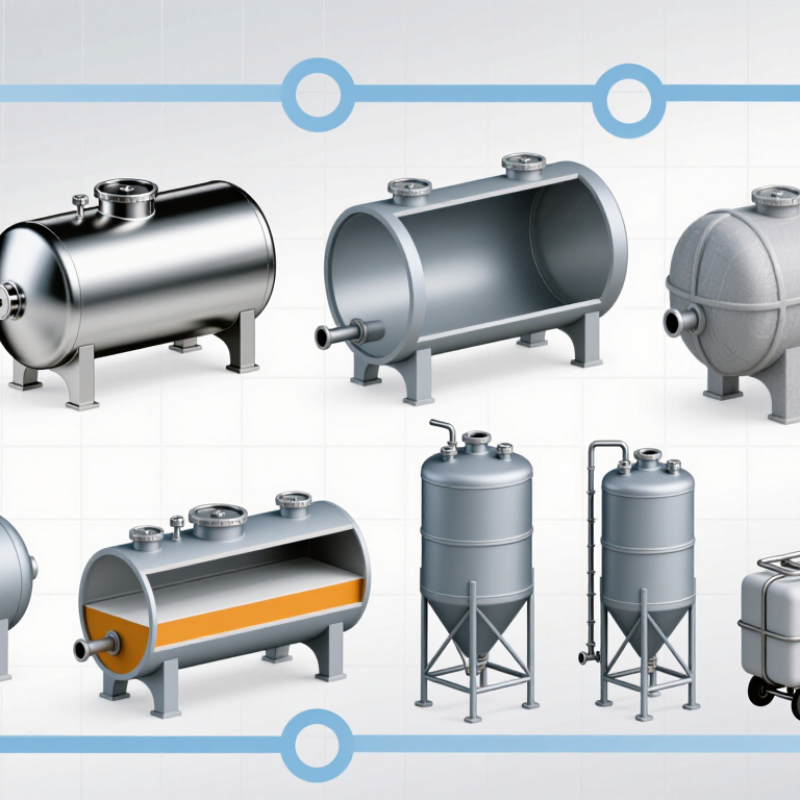
Selection Criteria: Chemical Compatibility, Capacity, and API 650 Design
Chemical tank selection starts with the liquid, not the tank shape. Acids, solvents, and alkaline solutions can react differently with the same metal. Check the chemical’s concentration, temperature, and possible impurities against the tank wall, lining, gaskets, and fittings. Compatibility is a system question. A corrosion-resistant shell can still fail at a seal.
Capacity should reflect usable volume, not just the tank’s nameplate figure. Allow room for thermal expansion, safe filling, and the actual transfer rate. A site receiving intermittent deliveries may need more reserve than its daily average suggests. Small details matter. Confirm the operating level, drainage needs, and available foundation space before fixing dimensions.
API 650 is relevant to many welded steel storage tanks, but it is not a universal design route for every chemical tank or material. Where it applies, review design conditions, corrosion allowance, roof and shell details, and foundation assumptions with a qualified engineer. The standard does not replace chemical compatibility checks. In practice, supplier data sheets may omit temperature peaks or cleaning chemicals. That gap matters. Treat uncertain operating data as an open design question, rather than guessing and locking in a tank specification.
Top 10 Types of Chemical Tanks for Industrial Use — Selection Criteria: Chemical Compatibility, Capacity, and API 650 Design
| Tank Type | Typical Construction and Service | Indicative Capacity | Chemical Compatibility Considerations | API 650 Design Relevance | Key Selection Criteria |
|---|---|---|---|---|---|
| 1. Vertical Fixed-Roof Tank | Welded carbon or stainless steel; commonly used for atmospheric bulk storage of liquids. | About 50–100,000+ m³, depending on design and site. | Select shell, bottom, roof, gasket, and coating materials for the chemical, concentration, temperature, and vapor space. | A common API 650 application for welded, vertical, cylindrical, aboveground tanks operating near atmospheric pressure. | Consider vapor control, venting, corrosion allowance, foundation, and secondary containment. |
| 2. External Floating-Roof Tank | Large vertical steel tank with a roof that floats directly on the liquid surface. | Typically several hundred to over 100,000 m³. | Suitable only where the stored liquid and vapor-control arrangement are compatible with exposed seals, roof fittings, and tank materials. | API 650 includes design provisions for applicable welded steel floating-roof tanks. | Assess roof drainage, seal design, wind and seismic loads, emissions requirements, and product volatility. |
| 3. Internal Floating-Roof Tank | Fixed-roof tank fitted with an internal floating cover to reduce vapor space exposure. | Commonly hundreds to tens of thousands of m³. | Check compatibility of the floating cover, seals, supports, and roof-space components with liquid and vapor conditions. | The steel tank may be designed to API 650 where within its scope; the internal floating roof must also meet applicable design requirements. | Useful when vapor loss control is needed while retaining a weather-protective fixed roof. |
| 4. Horizontal Cylindrical Tank | Steel or plastic vessel installed aboveground or underground; often used for smaller inventories and process storage. | Often about 1–100 m³; larger custom units are possible. | Verify the tank material, lining, seals, and fittings against the chemical and operating temperature. | Generally not the typical API 650 geometry; use the applicable product, local, or pressure-vessel standard for the specific design. | Check support saddles, anchorage, burial loads if underground, access, and leak detection. |
| 5. Pressure Vessel Tank | Designed for pressure or vacuum beyond the limits of an atmospheric storage tank; typically steel construction. | From a few litres to hundreds of m³, depending on pressure and application. | Material selection must account for corrosion, chemical attack, design pressure, temperature, and possible stress-corrosion mechanisms. | API 650 is not intended for pressure vessels; a pressure-vessel code, such as ASME Section VIII where applicable, is commonly used. | Confirm design pressure, relief protection, inspection requirements, and jurisdictional rules. |
| 6. Fiberglass-Reinforced Plastic (FRP) Tank | Composite tank with a resin-based corrosion barrier reinforced with glass fiber; used in many corrosive services. | From small process tanks to several hundred m³, depending on construction and service. | Compatibility depends strongly on resin type, chemical concentration, temperature, permeation, and exposure duration; confirm with the manufacturer’s data. | Not an API 650 steel tank. Common FRP design standards include ASTM D3299 for filament-wound tanks and ASTM D4097 for contact-molded tanks, as applicable. | Evaluate UV exposure, fire requirements, structural loads, resin selection, and inspection method. |
| 7. Polyethylene (PE) Tank | Usually a molded thermoplastic tank for atmospheric, low-pressure chemical storage. | Commonly about 0.1–100 m³; larger sizes depend on design and installation. | Check chemical-specific resistance, temperature limits, permeation, environmental stress cracking, and density-related structural limits. | Not covered by API 650. ASTM D1998 is a commonly used standard for upright polyethylene storage tanks where applicable. | Consider outdoor exposure, support surface, connections, thermal expansion, and maximum liquid specific gravity. |
| 8. Lined Steel Tank | Steel tank protected internally by a compatible lining, coating, or sheet lining. | Can range from small process vessels to large bulk-storage tanks. | The lining must resist the exact chemical, concentration, temperature, cleaning method, and abrasion; holidays or damage can expose the substrate. | A welded vertical steel tank may use API 650 if within scope; lining selection and application require separate specification and quality control. | Specify surface preparation, lining thickness, cure, spark testing where appropriate, and repair procedures. |
| 9. Double-Wall Tank | Primary tank surrounded by a secondary containment wall or shell, with a monitored interstitial space in many designs. | Available in small packaged sizes and large site-built configurations. | The primary tank must be compatible with the stored chemical; secondary containment materials must tolerate potential leakage and site conditions. | API 650 may apply to an eligible welded steel primary tank; the secondary containment and monitoring system need separate design criteria. | Assess leak detection, containment volume, inspection access, drainage, and applicable environmental rules. |
| 10. Refrigerated or Cryogenic Storage Tank | Insulated tank system for liquefied gases or other products stored at low temperatures; may use single- or double-containment arrangements. | From small vessels to very large installations, depending on product and storage temperature. | Materials must retain toughness at the minimum design temperature; consider thermal contraction, insulation, vapor management, and product hazards. | Not a routine API 650 application. Refrigerated low-pressure and cryogenic tanks require specialized standards and design provisions appropriate to the product and jurisdiction. | Define minimum design temperature, boil-off handling, insulation system, containment philosophy, and emergency safeguards. |
Note: Capacity ranges are indicative, not code limits. Confirm chemical compatibility using the exact chemical composition, concentration, operating temperature, and exposure conditions. API 650 applies only to tanks that meet its scope; verify the applicable edition, jurisdictional requirements, and project specifications with qualified engineering personnel.
Related Posts
-
How to Choose the Right Chemical Tanks for Your Needs
-
Top 10 Chemical Tanks You Need for Global Sourcing?
-
China Top Chemical Tanks Innovations and Market Trends?
-
2026 Top Chemical Tanks for Global Buyers Needs?
-
10 Essential Tips for Choosing Chemical Tanks for Your Needs?
-
What is Pump Metering and How Does it Benefit Your Business?