
A cabinet door may look simple, but its handle works every day. It is pulled with wet hands, bumped by grocery bags, and opened thousands of times. High Quality Cabinet Hardware can make those ordinary moments feel smoother—and keep a well-used kitchen functioning longer. That value is easy to miss in a showroom.
The NKBA’s 2024 Kitchen Trends Report and Houzz’s 2024 U.S. Kitchen Trends Study offer useful context: kitchen renovations involve many choices about function, finishes, and long-term use. Neither report isolates cabinet-hardware performance, so they should not be treated as proof that a particular handle or hinge will last. Still, their focus on practical design helps explain why small components deserve careful selection. Check the feel of a drawer slide, the hinge’s closing action, and whether the finish suits the room’s daily wear.
Design authority Charles Eames put the principle succinctly: “The details are not the details. They make the design.” It applies here, though appearance is only part of the decision. Solid construction, compatible sizing, and replacement availability matter too. A polished finish can still scratch; an expensive pull can still feel wrong in your hand. That is the part worth admitting. Choose hardware you can inspect, compare, and live with—not merely admire in a photograph.
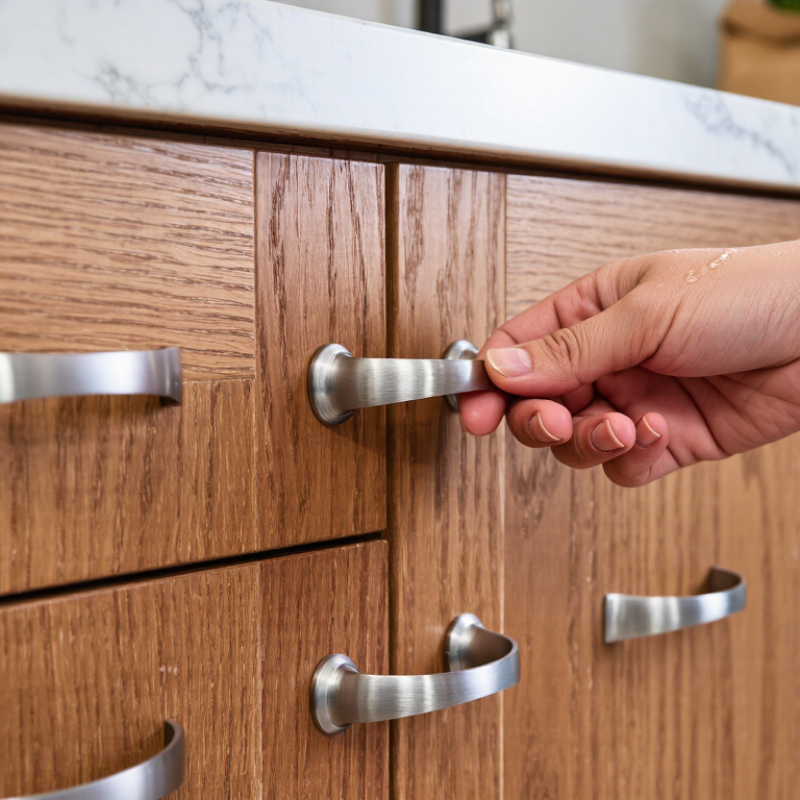
High-quality cabinet hardware is more than an attractive handle. It includes sturdy knobs, pulls, hinges, drawer slides, and the screws or mounting plates that keep each piece secure. Materials such as solid brass, stainless steel, and well-finished zinc alloys can offer dependable everyday use. The right choice depends on the cabinet’s weight, room conditions, and how often it is opened.
Look closely at the details. A pull should feel comfortable in your hand, with smooth edges and no sharp seams. Hinges should move evenly and hold doors aligned; soft-close features are useful, but proper adjustment still matters. Drawer slides should support the drawer’s load without scraping or wobbling. A durable finish should appear consistent around corners and contact points, where wear often shows first. I used to focus mainly on appearance. That missed the practical details.
Cabinet hardware is touched hundreds of times, yet its weak points often hide inside the mechanism. The International Stainless Steel Forum defines stainless steel as containing at least 10.5% chromium, which helps form a protective surface layer. That figure matters, but it is not a guarantee against corrosion: alloy quality, finish, cleaning products, and damp air all affect durability. Near a sink, a poorly protected screw can stain a cabinet even when the handle still looks new.
Construction matters just as much as material. The BHMA A156.9 standard evaluates cabinet hardware for performance, including strength and operation; a smooth showroom demonstration alone tells you little about long-term wear. Look for firmly attached posts, aligned hinge leaves, and drawer slides that move without scraping when loaded. Thin plating may chip at sharp edges, while loose joints can gradually widen screw holes. Solid brass can develop a patina, which some owners like and others mistake for damage. That distinction is easy to miss. Even a well-made pull can feel disappointing if its screws are too short for the cabinet door. Check the fit, finish, and load rating for the actual installation—not just the material name.
| Material or Construction | Performance Characteristics | Key Trade-Offs | What to Check Before Buying |
|---|---|---|---|
| Solid brass | Offers substantial weight and good resistance to corrosion in typical indoor settings. Often used for knobs, pulls, and decorative hardware. | Generally costs more than common zinc-alloy options and can develop natural surface changes if left unlacquered. | Check whether the finish is lacquered or intended to age naturally, and confirm that the item is solid brass rather than brass-plated. |
| Stainless steel | Provides good strength and corrosion resistance. It is a practical choice for kitchens and other areas where hardware is handled frequently. | Corrosion resistance depends on the stainless-steel grade and the surrounding conditions; “stainless” does not mean stain-proof. | Look for the stated steel grade when available, smooth edges, and a finish that is suitable for the intended environment. |
| Zinc alloy | Can be die-cast into detailed shapes and is commonly used for decorative knobs and pulls with a range of plated or coated finishes. | Performance depends on the alloy, part thickness, finish, and casting quality. Thin or poorly finished parts may be more vulnerable to damage. | Inspect the finish for even coverage and ask whether the pull or knob is solid, hollow, or supported by a reinforced mounting area. |
| Aluminum | Lightweight and naturally protected by a thin oxide layer. Anodized finishes can add surface protection and color. | Typically less dense than brass or steel, so the design and wall thickness matter for resistance to bending or denting. | Check the stated finish, material thickness, and how securely the hardware attaches to the cabinet. |
| Solid or reinforced handle construction | A well-supported handle can distribute pulling force across its mounting points and feel more stable during repeated use. | Material alone does not determine strength; shape, thickness, mounting distance, and fastener quality also affect performance. | Check for a rigid feel, cleanly finished mounting points, and fasteners suited to the cabinet door or drawer thickness. |
| Hinges with adjustable settings | Adjustment features can help align cabinet doors and maintain even gaps after installation or minor movement. | Adjustment range and ease of access vary by hinge design. A hinge still needs correct installation and suitable door support. | Confirm the hinge type, adjustment directions, opening angle, overlay or inset compatibility, and stated load guidance. |
| Quality fasteners and moving parts | Consistent threading, smooth movement, and properly fitted components help hardware operate reliably and remain secure. | Small components can wear or loosen over time, especially when they are poorly fitted or used with unsuitable screws. | Look for smooth operation, secure connections, included compatible screws, and replaceable parts where relevant. |
Buying takeaway: High-quality cabinet hardware is worth considering when its material, finish, construction, and fit match the room and expected use. Compare the complete assembly—not just the visible surface—and follow the manufacturer’s installation and care instructions.
Cabinet hardware earns its value through repeated, ordinary use. A drawer should glide when one hand holds a mug; a cabinet door should close without a sharp bang. Smooth movement reduces small daily annoyances, while a secure grip helps when hands are wet or full. Details matter.
The 2024 U.S. Houzz Kitchen Trends Study surveyed 1,715 homeowners renovating, completing, or planning a kitchen renovation. It tracks widespread investment in kitchens, though it does not measure hardware lifespan. For a technical benchmark, ANSI/BHMA A156.9 specifies performance tests for cabinet hardware. Ask suppliers about tested cycle life, load capacity, finish resistance, and warranty terms. Vague claims like “heavy duty” are hard to compare.
Better hinges can keep doors aligned, and well-made slides can prevent a loaded drawer from catching. That means fewer nudges, less rattling, and easier access to cookware at the back. Not magic. Installation still matters: loose screws or an uneven cabinet can make good hardware feel poor. And expensive pulls may add little if their shape is uncomfortable to grip. Test the handle with your usual motion, and open a fully loaded drawer before choosing.
Better hardware can make repeated opening and closing feel smoother and more dependable.
The chart shows estimated annual open-close cycles, calculated from the example daily-use assumptions shown. These are illustrative scenarios, not survey results or product test data. Hardware quality matters because small differences in movement and reliability are experienced repeatedly over time.
Why Is High Quality Cabinet Hardware Worth Buying?
Why Durability Can Lower Long-Term Costs
A loose pull is a small annoyance until it catches a sleeve or leaves a drawer hard to open. Then come the replacement part, time spent fitting it, and sometimes a second repair when screw holes have widened. Those costs are easy to miss at checkout. NIST’s Handbook 135 life-cycle costing method counts purchase, maintenance, and replacement costs, not just the initial price. That is a useful way to compare cabinet hardware.
Performance testing offers another clue. The Builders Hardware Manufacturers Association’s ANSI/BHMA A156.9 standard tests cabinet hardware for factors such as operating cycles, load, and finish. For drawer slides, the standard’s performance grades include cycle tests of 25,000, 50,000, and 100,000 cycles. These are test thresholds, not promises that a product will last a particular number of years. Still, stronger test performance can matter on a frequently used kitchen drawer. Quiet close. No wobble.
For a fair comparison, count how many pieces you need, check the stated test grade, and consider whether parts can be replaced individually. A lower-priced handle may be perfectly adequate in a guest room. In a busy kitchen, repeated loosening or finish wear can make the cheaper choice cost more over time. I would not assume every expensive fitting is better; installation and daily use matter, too. Keep that uncertainty in the calculation.
Choosing cabinet hardware starts with how each door and drawer is used, not just how it looks. Measure existing hole spacing before shopping; replacement pulls must match or leave visible holes. For new cabinets, mark a consistent position with a template, then check that fingers clear nearby walls and trim. A small knob can feel neat on a shallow drawer, while a longer pull is easier to grasp on a wide, heavy drawer. Try the grip. That detail matters.
Compare materials and finishes in the room’s actual light. Brushed metal tends to disguise fingerprints better than a polished surface, while painted finishes can show chips around frequently handled edges. Kitchens and bathrooms expose hardware to moisture, grease, and repeated cleaning, so check care instructions and choose sturdy construction. Hold a sample against cabinet doors; colors can shift beside warm wood or cool stone. There is no universal best finish. I’d reconsider matching every piece exactly: coordinated shapes or tones can look intentional without making the room feel overly uniform. Before installation, test one handle and open the cabinet fully. Awkward reach is easy to miss on a screen, and annoying every day.