Top 10 Types of Chemical Mixers for Global Buyers

Choosing a chemical mixer is not a simple catalog exercise. Viscosity, solids loading, vessel geometry, temperature, and shear sensitivity all shape the result. A mixer that blends a thin solvent well may fail beside a 2,000-litre tank holding abrasive slurry.

Industry demand is also becoming more technically demanding. The International Energy Agency’s The Future of Petrochemicals report identifies chemicals as a major industrial energy consumer. Grand View Research’s Industrial Agitators Market analysis also points to continued growth, supported by pharmaceutical, food, water-treatment, and specialty-chemical production. These reports suggest a wider equipment market, but not an easier buying decision. Numbers vary between research firms. That deserves caution.

“Mixing is the process of reducing or eliminating concentration gradients,” wrote Dr. James Y. Oldshue in Mixing Technology. His definition remains practical. It directs attention toward measurable outcomes, such as uniform pH, stable viscosity, complete powder wetting, and predictable residence time. It also exposes a common mistake: selecting a chemical mixer from motor power alone.

This guide examines ten major mixer types used by global buyers, including propeller, turbine, anchor, high-shear, static, and planetary designs. Each has a different operating window. Some protect delicate emulsions. Others disperse powders aggressively. Site conditions matter more than attractive specifications. A wrong choice can create dead zones, excessive heat, seal failure, or costly rework. The recommendations here combine process fundamentals, supplier documentation, and real-world selection checks. They are useful, but not infallible. Pilot testing still matters.
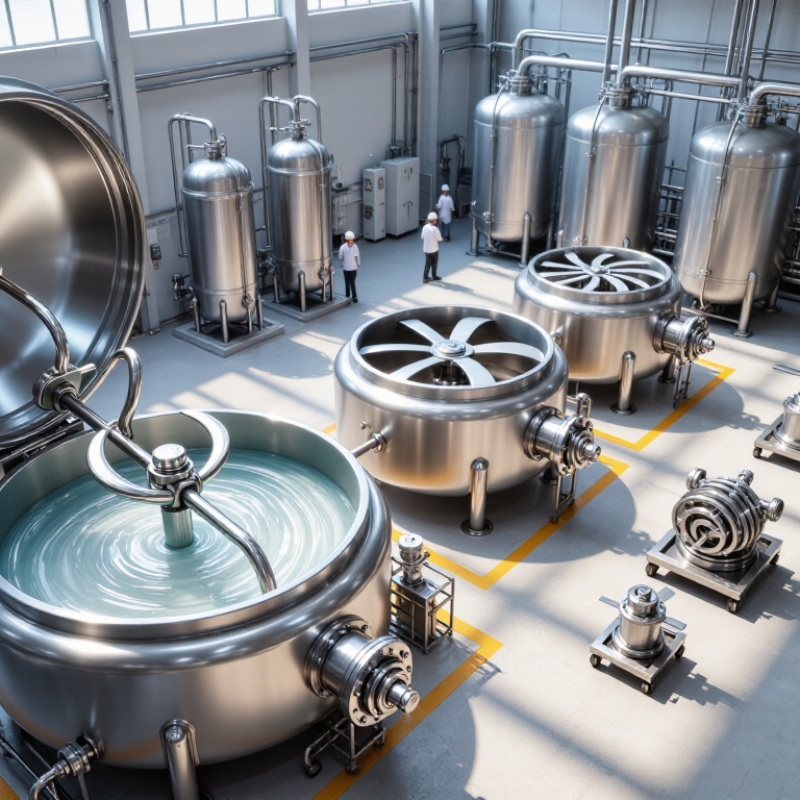
Top 10 Types of Chemical Mixers for Global Buyers

Chemical Mixer Taxonomy: Ten Designs Classified by Flow, Shear, and Duty

Top 10 Types of Chemical Mixers for Global Buyers

Chemical mixer selection begins with flow, shear, and duty. MarketsandMarkets’ 2024 mixing equipment report projects steady market growth through 2028, driven by chemical, water, and pharmaceutical processing. That growth does not make every mixer suitable. Propeller mixers provide axial flow for low-viscosity blending. Paddle mixers offer gentle movement in tanks with suspended solids. Turbine mixers create stronger radial flow for gas dispersion and heat transfer. Hydrofoil mixers reduce power demand during bulk circulation. Energy savings matter.

Anchor mixers scrape vessel walls and suit viscous products. Helical-ribbon mixers handle pastes, powders, and high-solids batches. Rotor-stator mixers generate intense shear for emulsions and particle reduction. High-shear dispersers wet powders rapidly, but they can raise temperature. Static mixers use fixed elements inside pipelines, delivering continuous blending without a motor. Planetary mixers combine orbital movement with strong local shear for adhesives, sealants, and dense compounds. Ten designs. Different duties.

The U.S. Department of Energy notes that motor-driven systems can represent a major share of industrial electricity use, although site conditions change the result. Buyers should compare torque, tip speed, residence time, cleanability, and seal performance. A 3,000-liter tank may need circulation, not maximum shear. This is often overlooked. Shear-sensitive materials can lose quality under aggressive mixing. My practical concern is simple: published power figures rarely match every viscosity curve, batch level, or impeller position. Pilot testing remains imperfect, but it exposes those gaps before installation.

Top 10 Types of Chemical Mixers for Global Buyers

Chemical Mixer Taxonomy: Ten Designs Classified by Flow, Shear, and Duty

The chart compares common mixer designs using relative engineering bands from 1 to 5. Shear intensity ranges from gentle blending to very high dispersion or emulsification, while viscosity duty ranges from low-viscosity liquids to highly viscous or paste-like materials. Actual performance depends on vessel geometry, impeller size, speed, power input, temperature, solids loading, and process objectives.

Low-Viscosity Selection: Propeller, Turbine, Paddle, Anchor, and Ribbon Mixers

Top 10 Types of Chemical Mixers for Global Buyers

Low-viscosity fluids look easy to mix. They are not. For water-like chemicals, propeller mixers usually deliver strong axial circulation with modest power. Turbine mixers create more radial flow and suit gas dispersion, suspension, and moderate shear. Paddle mixers move gently, making them useful for blending fragile ingredients or preventing surface disturbance. Keep the impeller submerged. Otherwise, a visible vortex may add air instead of improving uniformity.

Anchor mixers are not the default choice for low-viscosity service. Their wall-scraping action helps with heat transfer and temperature control, especially in jacketed vessels. Ribbon mixers normally fit powders, pastes, or mixed-phase materials better than thin liquids. For simple liquid blending, they can consume unnecessary power. Geometry matters. Tank diameter, liquid height, baffles, impeller diameter, and tip speed should be checked together. Grand View Research reported that the global industrial mixers market was valued at roughly USD 2 billion in 2023, while MarketsandMarkets projected continued growth through 2029. These estimates use different market scopes, so buyers should compare definitions carefully. I would not trust a catalog selection alone. A pilot test with dyed water, actual density, and operating temperature can expose vortexing, dead zones, or unexpected foaming. One practical mistake remains common: choosing horsepower before confirming the required flow pattern.

High-Shear and Inline Options: Static, Rotor–Stator, Planetary, Banbury, and Jet Mixers

Global buyers need more than a mixer’s advertised speed. Process viscosity, solids, batch size, temperature, and cleaning access shape the decision. Static mixers use fixed elements inside a pipe, creating continuous blending without moving parts. They suit low-to-medium viscosity streams and consistent flow. Inline rotor-stator mixers add intense shear for emulsions, dispersions, and rapid wetting. They need careful gap control and may increase heat.

For thick formulations, planetary mixers provide strong folding and wall-scraping action. Vacuum capability can reduce trapped air in sealants, pastes, and dense compounds. Banbury mixers handle demanding rubber-like or highly viscous materials through enclosed, high-torque kneading. They require robust cooling and planned maintenance. Jet mixers use fluid energy to circulate liquids in tanks. They work well when gentle bulk turnover matters, but poor nozzle placement can leave quiet zones.

Selection should begin with a measured trial, not a brochure. Record torque, temperature rise, mixing time, and sample uniformity. Inline systems save floor space, yet pumps and piping become part of the mixing system. This is easy to overlook. Static designs are simple, but they cannot correct an unstable feed. Rotor-stator units disperse quickly, though excessive shear may damage sensitive ingredients. Planetary and Banbury equipment often costs more to clean and validate. A pilot test with real solids and realistic viscosity remains the most reliable purchasing evidence. Even then, scale-up can surprise you.

Engineering Benchmarks: Re <10, Re >10,000, P/V, Tip Speed, and Scale-Up

Top 10 Types of Chemical Mixers for Global Buyers

Mixer selection starts with flow regime, not vessel shape. For Re below 10, molecular forces dominate, so anchor, gate, and helical-ribbon mixers suit viscous fluids. Between roughly 10 and 10,000, transitional behavior demands careful testing. Above 10,000, turbulent flow supports propeller, turbine, pitched-blade, hydrofoil, paddle, rotor-stator, and high-speed disperser designs. Static mixers complete the list, especially for continuous pipelines. These ranges follow standard chemical-engineering practice, including Reynolds-number methods described in Perry’s Chemical Engineers’ Handbook.

Power per volume, P/V, is often the most practical scale-up benchmark. A laboratory vessel may need 0.5–2 kW/m³ for gentle blending, while gas dispersion or solid suspension can require several kW/m³. The actual value depends on viscosity, density, solids loading, and target quality. Tip speed matters too. A 1.5 m impeller turning at 90 rpm reaches about 7.1 m/s. High tip speed improves dispersion, but it can increase shear, heat, and seal stress. The 2022 U.S. Department of Energy Industrial Decarbonization Roadmap identifies process efficiency as a major industrial improvement pathway.

For scale-up, holding P/V constant is useful, but incomplete. Constant tip speed may protect particles or cells, while constant pumping capacity may better preserve circulation. I have seen designs fail when only rpm was copied. Pilot trials should record torque, temperature rise, mixing time, and wall clearance. One uncomfortable truth remains: a published benchmark is a starting point, not proof of performance. Each fluid earns its own test.

Global Buyer Compliance: IEC 60079, ASME BPE, and FDA 21 CFR 210–211

Top 10 Types of Chemical Mixers for Global Buyers

Selecting a chemical mixer involves more than capacity, viscosity, and motor power. Global buyers must match equipment design with process hazards and regulated production requirements. IEC 60079 is critical when mixers operate in explosive atmospheres. It guides equipment selection, protection methods, temperature limits, and installation practices. The classified area must be confirmed before specifying motors, instruments, and electrical enclosures.

For pharmaceutical and biotechnology applications, ASME BPE supports hygienic equipment design. Buyers should examine surface finish, weld quality, drainability, and cleanability. Avoid unnecessary dead legs around shafts, seals, and sampling points. FDA 21 CFR 210–211 focuses on cGMP controls for drug manufacturing. It does not simply “approve” a mixer. Instead, the mixer should support documented cleaning, process consistency, material traceability, and validated operating procedures.

Documentation matters. Request material certificates, weld records, surface-finish reports, calibration data, and applicable hazardous-area documentation. Check whether the supplied configuration matches the reviewed drawings. Small gaps matter. A technically impressive mixer can still create compliance problems through poor access, unclear maintenance records, or unsuitable elastomers. Buyers should also review change-control procedures and spare-part specifications before commissioning. A perfect checklist may miss real cleaning difficulties, so factory acceptance testing and operator feedback remain valuable. This practical review is often where hidden risks appear.

Top 10 Types of Chemical Mixers for Global Buyers - Global Buyer Compliance: IEC 60079, ASME BPE, and FDA 21 CFR 210–211

No. Mixer Type Primary Mixing Mechanism Typical Chemical Duties Common Construction Materials Hygienic / FDA 21 CFR 210–211 Considerations IEC 60079 Considerations ASME BPE Relevance Best-Fit Vessel or Process
1 Propeller Mixer Axial-flow circulation with relatively high pumping capacity and moderate shear. Low- to medium-viscosity liquid blending, dilution, suspension maintenance, and heat-transfer improvement. Stainless steel, nickel alloys, lined steel, or corrosion-resistant plastics, depending on the chemistry. For regulated production, product-contact surfaces should be cleanable, drainable, corrosion-resistant, and compatible with validated cleaning procedures. If installed in a classified area, the motor, electrical equipment, seals, and instrumentation require suitable hazardous-area assessment and certification. Applicable when used in bioprocess equipment requiring hygienic design, sanitary connections, and documented surface-finish requirements. Tall tanks, storage vessels, water-treatment tanks, and low-viscosity batch processes.
2 Radial-Flow Turbine Mixer Radial discharge that produces strong local turbulence and gas-dispersion capability. Gas-liquid dispersion, liquid blending, moderate solids suspension, and chemical reaction service. Stainless steel, carbon steel with suitable lining, nickel alloys, and other materials selected for corrosion and erosion resistance. For pharmaceutical use, crevice-free construction, suitable seals, cleanable geometry, and controlled product-contact materials are important. Potential ignition sources include the motor, static discharge, mechanical seals, and overheating; the complete installation must be evaluated for the classified zone. Used where a hygienic turbine design is required; ASME BPE is not automatically applicable to every chemical-duty installation. Reactors, aeration vessels, gas dispersion systems, and liquid-liquid processing tanks.
3 Hydrofoil Mixer High-efficiency axial flow with strong bulk circulation and comparatively low power per unit volume. Large-volume blending, solids suspension, temperature equalization, and gentle treatment of shear-sensitive materials. Stainless steel, duplex stainless steel, nickel alloys, or lined materials selected for the process fluid. Can support hygienic processing when the impeller, shaft, seals, and vessel are designed for effective cleaning and product-contact control. Hazardous-area compliance generally focuses on the drive assembly, electrical classification, grounding, and prevention of excessive surface temperature. May be incorporated into ASME BPE-oriented systems when the full equipment design meets applicable hygienic and fabrication requirements. Large storage tanks, wastewater systems, crystallization tanks, and low- to medium-viscosity bulk liquids.
4 Pitched-Blade Turbine Mixer Combined axial and radial flow created by angled blades. General-purpose blending, solids suspension, heat-transfer enhancement, and liquid-liquid mixing. Stainless steel, coated carbon steel, duplex alloys, or nickel-based alloys for aggressive fluids. Suitable for hygienic service only when the vessel and mixer provide appropriate drainage, cleanability, surface condition, and seal integrity. The selected motor and accessories may need equipment protection appropriate to the gas, vapor, mist, or dust classification. Relevant for sanitary process vessels when design details align with applicable ASME BPE principles. Batch reactors, blending tanks, suspension duties, and multipurpose process vessels.
5 Anchor Mixer Close-clearance, low-speed sweeping action along the vessel wall and bottom. High-viscosity blending, wall heat-transfer control, creams, pastes, resins, and products prone to wall buildup. Stainless steel, nickel alloys, glass-lined steel, or specialized coatings for corrosive and viscous products. For pharmaceutical and food-related service, dead-leg minimization, hygienic seals, drainability, and validated cleaning are key considerations. High torque and possible frictional heating require appropriate mechanical protection, temperature monitoring, grounding, and classified-area equipment selection. Common in hygienic high-viscosity vessels when fabrication, surface finish, elastomers, and cleaning provisions meet the required specification. Jacketed vessels, cream and ointment tanks, resin reactors, and high-viscosity batch systems.
6 Helical Ribbon Mixer Large-surface-area helical movement designed for intensive axial and radial displacement in viscous materials. Highly viscous liquids, gels, pastes, filled polymers, adhesives, and solid-liquid blends. Stainless steel, nickel alloys, abrasion-resistant alloys, or lined construction based on product compatibility. Cleaning validation can be challenging because of close clearances and complex geometry; hygienic design must be assessed for the specific product and cleaning method. Torque, friction, dust generation, and mechanical heating should be reviewed where flammable vapors or combustible dusts may be present. Potentially applicable to hygienic powder or viscous-product systems, subject to design-specific ASME BPE requirements. Heavy-duty batch mixers, paste systems, polymer processing, and high-solids formulations.
7 Rotor-Stator High-Shear Mixer High localized shear generated in a narrow rotor-stator gap for rapid dispersion and droplet or particle-size reduction. Emulsification, deagglomeration, dissolution assistance, pigment dispersion, and fine suspension preparation. 316L stainless steel, hardened alloys, ceramic components, or corrosion-resistant materials selected for wear and product compatibility. Product-contact finish, seal selection, cleanability, heat generation, and particle-shedding control are important for FDA-regulated manufacturing. High speed and friction can create heat and ignition risks; motor protection, temperature control, grounding, and area classification must be considered. Inline or bottom-entry sanitary versions may be used in bioprocessing when the complete design satisfies the applicable hygienic requirements. Emulsion systems, pharmaceutical suspensions, cosmetics, and high-shear inline processing loops.
8 Inline High-Shear Mixer Continuous pumping through a high-shear rotor-stator or similar mixing element. Continuous emulsification, rapid dispersion, powder wet-out, recirculation mixing, and controlled product homogenization. 316L stainless steel, nickel alloys, engineered polymers, and wear-resistant components as required by the process. Sanitary piping, drainable housings, hygienic connections, suitable elastomers, and documented cleaning or sterilization procedures are commonly required. The pump, motor, seals, control panel, and instrumentation must be evaluated as part of the complete hazardous-area installation. Strong relevance in continuous bioprocess and pharmaceutical systems where sanitary piping and hygienic equipment design are specified. Continuous production lines, recirculation loops, emulsification skids, and powder induction systems.
9 Static Mixer Fixed internal elements divide, redirect, and recombine flowing streams without a rotating shaft. Continuous liquid blending, neutralization, polymer dosing, gas-liquid contact, and inline heat or mass transfer. Stainless steel, plastic-lined steel, fluoropolymers, fiberglass-reinforced plastics, and other chemically compatible materials. The housing and internal elements should be designed for cleanability, drainage, material compatibility, and prevention of product retention where regulated products are processed. No rotating drive is present, but static charge, conductive bonding, flow-generated electrostatic effects, and upstream equipment still require assessment. Sanitary static mixers can be integrated into ASME BPE-oriented piping systems when the housing, connections, materials, and surface finish meet project requirements. Continuous pipelines, dosing systems, water treatment, chemical injection, and compact process skids.
10 Magnetic-Drive Mixer Torque is transferred through a magnetic coupling, allowing a sealed containment boundary without a conventional dynamic shaft seal. Toxic, volatile, sterile, oxygen-sensitive, or contamination-sensitive liquid mixing. 316L stainless steel, nickel alloys, glass-lined components, high-performance polymers, and compatible containment materials. The sealed design can reduce leakage and contamination pathways; product-contact materials, surface finish, cleaning, sterilization, and seal-free containment still require validation. Magnetic coupling, motor temperature, containment integrity, grounding, and electrical equipment selection should be reviewed for the classified location. Highly relevant to sterile and bioprocess vessels when the vessel, mixer, connections, materials, and fabrication comply with the applicable ASME BPE specification. Closed reactors, sterile vessels, hazardous-liquid systems, and applications requiring low-emission containment.
Compliance note: IEC 60079 addresses equipment and systems for explosive atmospheres; the applicable protection concept, gas or dust group, temperature class, equipment protection level, and installation requirements depend on the site classification. ASME BPE provides design and fabrication guidance for bioprocessing and pharmaceutical equipment and piping. FDA 21 CFR Parts 210–211 establish current good manufacturing practice requirements for drug manufacturing; they do not certify a mixer by themselves. Final compliance depends on the complete mixer, vessel, drive, seals, materials, installation, documentation, cleaning process, and site-specific risk assessment.