
7 Mattress Display Rack Buying Tips for Retailers

Choosing a Mattress Display Rack affects more than how a showroom looks. It shapes how easily shoppers can compare sizes, feel materials, and move around the floor. A rack that fits the space but blocks a nearby aisle can create daily friction. Small details matter.

Before comparing styles, measure the display area and note doorways, columns, and walking paths. Check the rack’s supported mattress sizes, stated weight capacity, frame materials, and assembly requirements. Ask how samples are secured and whether staff can change them without lifting awkwardly. These practical checks help prevent a rack from becoming a costly fit problem. Easy to overlook.

The seven tips in this guide focus on stability, capacity, access, visibility, durability, flexibility, and total value. They offer a useful framework for comparing product specifications with the realities of your store. For example, a compact floor plan may benefit from a vertical design, while a high-traffic showroom may need wider customer access. Verify dimensions and load information with the supplier rather than relying on photos alone. A polished image cannot show every joint or finish. Retailers should also consider cleaning, rearranging, and replacing display models over time. A rack that works today may not suit a future layout, so some flexibility can be worth paying for. There is no perfect choice for every store; the right one balances safety, shopper comfort, and available space.
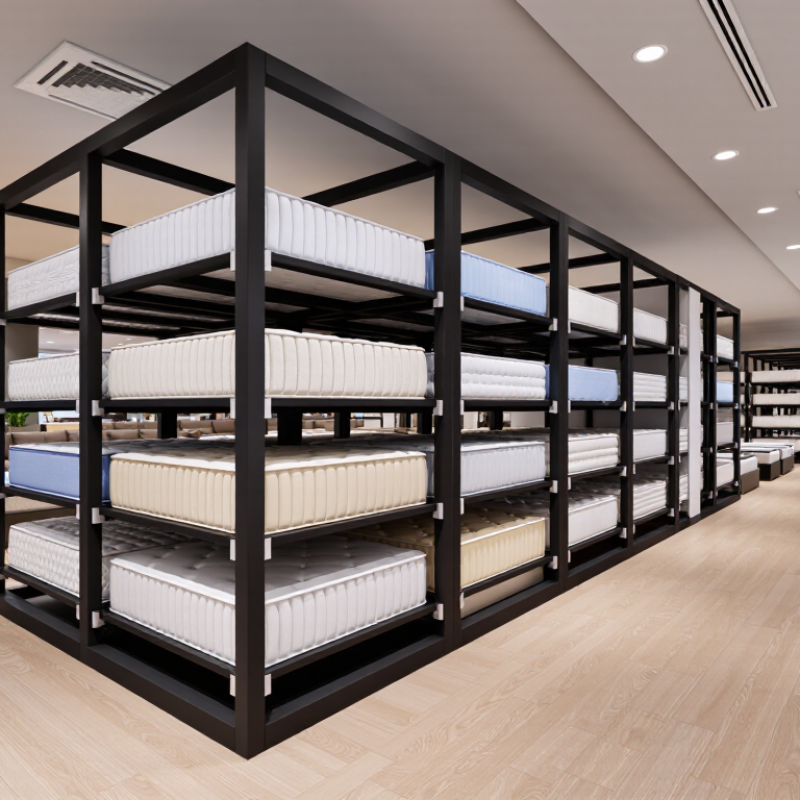
7 Mattress Display Rack Buying Tips for Retailers

Define Store Needs and Mattress Display Goals

Before selecting a mattress display rack, define what the store needs it to do. Measure the floor area, aisle width, ceiling height, and access routes for deliveries. Note which mattress sizes and thicknesses you carry. A rack that fits a showroom sample may not fit your full range. Count how many models shoppers should compare at once, and leave room to sit or lie down comfortably.

Tip: Sketch the display area before ordering. Mark the rack footprint, nearby doors, and customer paths. Then test the layout with cardboard or tape on the floor. It is a simple check, but it can reveal awkward turns and blocked sightlines.

Set a clear display goal, such as improving comparison between firmness levels or making sizes easier to find. Choose rack spacing and labels to support that goal. Consider how staff will replace mattresses and keep sample edges visible.

If customers need to lift a mattress corner, confirm the rack allows safe, easy access. I have seen tidy displays become cramped after new models arrive; leave a little spare capacity. Track which models shoppers handle and ask staff where congestion occurs. Adjust the layout when store use tells you the plan missed something.

Compare Rack Types for Different Mattress Sizes

Mattress sizes should determine the rack, not the other way around. In the U.S., a Twin is typically 38 by 75 inches, a Full 54 by 75, a Queen 60 by 80, and a King 76 by 80. Check local sizing before ordering; dimensions and naming can vary by market. A narrow, fixed-width rack may suit Twin and Full displays, while adjustable bays handle Queen and King models more flexibly. Measure the mattress itself, including any pillow-top overhang. A tight fit looks cramped.

For larger sizes, compare floor space, loading access, and frame support. A Queen or King needs a deeper, sturdier platform, plus enough aisle clearance for shoppers to view its edge without twisting around neighboring displays. Vertical racks save floor area, but lifting heavier mattresses onto upper levels can be awkward for staff. Modular racks are easier to reconfigure when a store changes its size mix; fixed racks may feel more stable but leave less room to adapt. Grand View Research estimated the global mattress market at USD 51.7 billion in 2023, reflecting a large and varied product category. That figure is not a rack specification. Still, it underlines why one-size-fits-all merchandising can miss real inventory differences. Test a loaded bay before buying. Check the corners, not just the center.

Check Load Capacity, Materials, and Safety Features

A mattress rack must carry more than the weight printed on a product tag. Check the load rating for each shelf and the entire unit, then compare it with the heaviest mattress combination you plan to display. Ask whether the rating assumes evenly distributed weight; stacked edges can concentrate pressure on a few bars. Leave a practical margin. A display may be rearranged by busy staff.

Material choice matters. Welded steel often suits heavier displays, while thinner tubing may flex under repeated loading. Inspect joints, feet, and finishes for cracks, wobble, sharp edges, or rust. If the rack sits on a smooth floor, test it under a gentle push. Small details matter. OSHA’s 29 CFR 1910.176(b) requires stored materials to be stable and secured against sliding or collapse; that principle is useful when arranging mattresses, too.

Add anti-tip restraints or floor anchoring when the rack’s design and site allow them, and keep aisles clear during restocking. The U.S. Bureau of Labor Statistics reported 2.4 nonfatal workplace injury and illness cases per 100 full-time workers in private industry in 2023. That broad figure is not specific to mattress displays, but it supports taking routine handling risks seriously. One imperfect check is to load the rack gradually and watch for movement; it cannot replace the manufacturer’s rated capacity or a competent inspection.

7 Mattress Display Rack Buying Tips for Retailers—Check Load Capacity, Materials, and Safety Features

How to use this chart: These common U.S. mattress dimensions can help you estimate the rack space needed. They are nominal sizes; actual products may vary. When choosing a rack, also confirm the manufacturer’s rated load capacity, inspect the frame and finish, and check for suitable restraints and anchoring. Mattress dimensions are not rack load ratings.

Plan for Floor Space, Customer Access, and Product Visibility

A mattress display rack can look compact on a floor plan and feel crowded in a real store. Measure the rack’s full footprint, including mattress overhang and space for customers to stand. Leave clear paths between displays, checkout areas, and exits. Keep aisle width consistent. A tape measure helps. Also mark the proposed layout on the floor before ordering; it is an easy step to skip, and regrettable later.

Customer access matters as much as capacity. Shoppers should be able to walk around a display, sit or lie down safely, and compare models without blocking others. Check that labels remain readable from the aisle and that lighting reaches the mattress surface. Tall racks may save floor space, but upper models can be difficult to inspect. Test visibility from several viewing angles. A display that looks tidy from the entrance may hide products behind posts or neighboring beds.

Before choosing a rack, review the store’s busiest routes and observe where people pause. Place popular sizes where customers can reach them comfortably, while keeping less frequently viewed items accessible. Leave room for staff to change bedding and replace labels. Plans change. Recheck the layout after installation; customer traffic may reveal bottlenecks that measurements alone missed.

Review Durability, Maintenance, and Total Cost of Ownership

A mattress display rack can look sturdy until it is moved across the sales floor. Check welds, joints, caster stems, and locking brakes, especially where frames meet under load. Ask for the rated capacity per bay and written test documentation; do not assume a thicker-looking frame carries more. Small parts fail. Keep a simple inspection log, noting loose bolts, chipped coatings, and wheels that drag. These details reveal wear before a rack becomes difficult to reposition or clean.

Total cost of ownership includes more than the purchase price. The U.S. Bureau of Labor Statistics reported that the Consumer Price Index rose 2.9% in the 12 months ending December 2024. This broad inflation measure is not a rack-price forecast, but it is a useful reminder to refresh replacement-cost estimates. NIST Handbook 135 recommends life-cycle cost analysis, which considers acquisition, operation, maintenance, and replacement costs. Compare racks over the same expected service period, and include staff time for repairs, cleaning, and downtime. A low quote can become expensive if casters need frequent replacement.

Tips: Measure aisles and turning space before ordering. Request prices for replacement wheels, fasteners, and finish repairs, not just the rack. Record inspection time during a trial period; estimates often miss it. Recheck load limits after changing the display layout, and revise the cost comparison when actual maintenance differs from the plan.