How to Choose the Best Mixer Pump for Your Needs?

Choosing the best mixer pump begins with understanding the work, not admiring the largest motor. A reliable selection must match the material, flow rate, pressure, installation space, and operating schedule. Concrete slurry, wastewater, chemical mixtures, and viscous liquids each respond differently to pumping forces. A unit that performs well in a clean workshop may struggle beside a muddy construction trench. Real conditions matter.

This guide examines mixer pump performance through practical experience and verified technical information. Manufacturer curves can reveal flow capacity, head pressure, motor load, and efficiency. However, printed specifications do not always reflect daily performance. Hose length, solids concentration, temperature, and poor maintenance can change results quickly. Check compatibility carefully. Safety features, corrosion resistance, seal quality, and access for servicing also deserve attention. Consulting qualified suppliers and reviewing recognized industry guidance can reduce costly mistakes. Still, no recommendation is universal. I have seen an apparently powerful pump fail because its inlet was too narrow and frequently blocked. That detail is easy to miss. It should not be.

The right mixer pump should provide stable mixing, predictable delivery, and manageable maintenance over time. Energy use matters, but downtime may cost more than electricity. Operators should consider noise, portability, spare parts, and future capacity before purchasing. A modest pump may be wiser for controlled workloads, while demanding applications require stronger construction and professional assessment. This article will help compare these factors clearly, question attractive but incomplete claims, and develop a choice based on evidence rather than guesswork.
How to Choose the Best Mixer Pump for Your Needs?

Define the Duty Point: Flow, Head, and a 10–20% Design Margin

Before comparing mixer pumps, define the duty point: the flow rate required at the total head the system must overcome. Flow is usually measured in gallons per minute or cubic metres per hour. Head includes elevation, pipe friction, bends, valves, and any outlet pressure. A pump that meets the flow target on paper may fall short once a long, narrow pipe is installed. Measure the route. Count the fittings, too.

Add a 10–20% design margin to cover reasonable uncertainty, such as changing liquid levels or minor pipe losses. Keep it grounded in the actual setup. Excessive allowance can push a pump away from its efficient operating range, waste energy, and increase wear. Check the pump curve against the required flow and head, not just the maximum figures on a product sheet. Those figures may describe different operating conditions.

Real systems rarely behave exactly as planned. A partly clogged strainer or thicker-than-expected mixture can shift performance. Leave room for that. But do not guess blindly. Record the liquid properties, pipe dimensions, and expected operating hours, then review the duty point with a qualified pump specialist. One detail is easy to miss: mixer performance and pumping duty are related, but they are not identical.

Match Pump Type to Fluid Viscosity, Solids, and Particle Size

How to Choose the Best Mixer Pump for Your Needs?

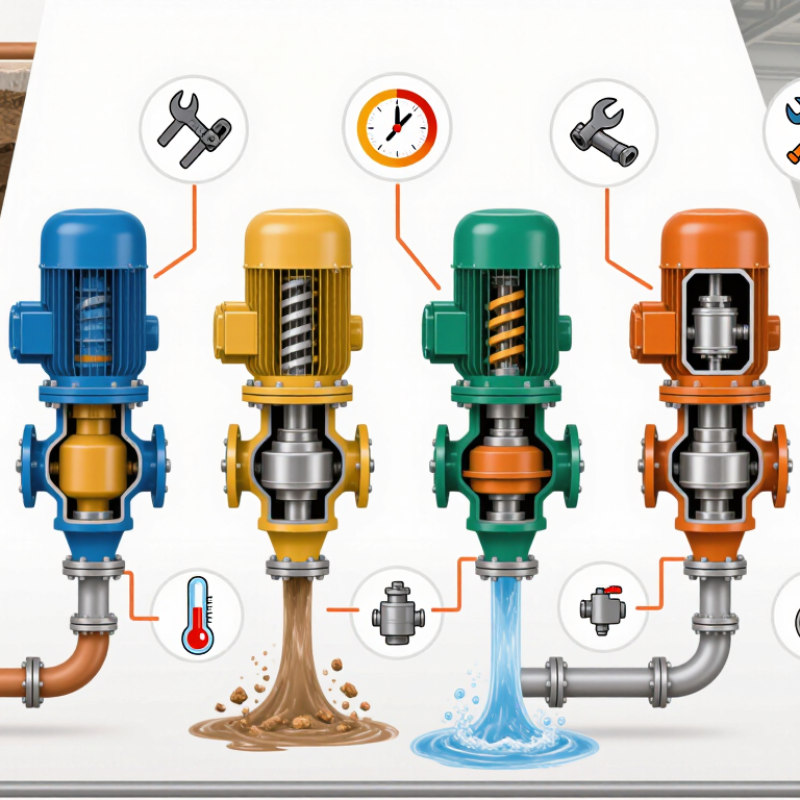
Fluid behavior should lead the selection, not motor size. Low-viscosity liquids usually suit centrifugal mixer pumps with open or semi-open impellers. Thick fluids need positive-displacement designs that maintain torque at lower speeds.

The U.S. Department of Energy reports that pumping systems can consume 25–50% of industrial facility electricity. Oversizing can therefore waste substantial energy.

Solids change the decision quickly. Record concentration, hardness, maximum particle diameter, and settling speed before choosing an impeller. A narrow passage may handle clear liquid efficiently, then clog when fibrous debris enters.

Vortex or recessed-impeller designs can provide more clearance for larger solids. Match the passage to the largest expected particle, not the average one. That detail is often missed.

Viscosity also reduces flow and increases power demand. Water-based performance curves cannot be transferred directly to syrup, sludge, or resin. Hydraulic Institute guidance recommends viscosity correction and documented operating conditions.

In field work, I check samples at actual temperatures because viscosity can change sharply during cooling. A laboratory number may still mislead. A jar test helps reveal settling, shear sensitivity, and mixing time.

I would also question any quotation based only on horsepower.

The U.S. DOE Pumping System Assessment Tool and ISO 14414 assessment practices support measuring flow, pressure, and operating hours before final selection.

Check NPSH: Keep NPSH Available Above Required by at Least 0.5 m

How to Choose the Best Mixer Pump for Your Needs?

When selecting a mixer pump, check NPSH before comparing motor power or flow rate. NPSH Available must exceed NPSH Required by at least 0.5 m. This margin helps prevent cavitation, which can cause noise, vibration, unstable performance, and impeller damage.

Calculate NPSH Available from the actual liquid level, surface pressure, vapor pressure, and suction-line losses. Liquid temperature matters greatly. Warmer liquid creates higher vapor pressure and reduces the safety margin. Elevation can also affect available pressure. Compare this result with the pump’s NPSH Required at your real flow rate, speed, and operating condition. A laboratory value may not represent a crowded plant layout.

Tips: Measure the suction pipe length and fittings carefully. Include strainers, valves, elbows, and temporary restrictions. Keep the suction line short and clean. Check the lowest operating liquid level, not the normal level. Small details matter. In practice, 0.5 m is a useful minimum, but it may not cover severe temperature changes or sudden flow variations. I would review the margin again after commissioning, because field conditions often differ from the design sheet. Listen for crackling sounds and watch for vibration. They may reveal a problem before the pressure calculation does.

How to Choose the Best Mixer Pump for Your Needs? — Check NPSH: Keep NPSH Available Above Required by at Least 0.5 m
Application Case Liquid Temperature
(°C)
Surface Pressure
(m absolute)
Vapor Pressure Head
(m)
Static Suction Head
(m)
Suction-Line Losses
(m)
NPSH Available
(m)
NPSH Required
(m)
Safety Margin
(m)
Selection Result
Open tank, sea-level water transfer 20 10.33 0.24 2.00 1.20 10.89 4.00 6.89 Pass
Warm process-water circulation 40 10.33 0.75 1.50 1.80 9.28 5.50 3.78 Pass
Hot-water tank with moderate suction losses 60 10.33 2.03 1.00 2.40 6.90 6.20 0.70 Pass
High-altitude installation at approximately 2,000 m 20 8.00 0.24 0.80 1.70 6.86 6.40 0.46 Review
Very hot liquid in an open tank 80 10.33 4.83 0.60 2.20 3.90 4.80 -0.90 Fail
Closed tank operating below atmospheric pressure 20 6.50 0.24 3.00 2.00 7.26 6.50 0.76 Pass
Calculation basis: NPSH Available = surface absolute pressure head − vapor pressure head + static suction head − suction-line losses. A practical selection should maintain NPSH Available at least 0.5 m above NPSH Required. Values are representative engineering examples for water-service evaluation and should be confirmed against the final system layout, liquid properties, operating temperature, altitude, and pump performance curve.

Size Motor Power from Hydraulic Efficiency, Often 50–80% in Practice

How to Choose the Best Mixer Pump for Your Needs?

Motor power should follow hydraulic demand, not guesswork. The core estimate is P = ρgQH ÷ η, where Q is flow, H is total head, and η is overall efficiency. In field applications, hydraulic efficiency often ranges from 50% to 80%. Slurry concentration, pipe friction, impeller clearance, and control settings can reduce it quickly. A pump moving thick wastewater may need far more motor power than a clean-water calculation suggests.

The U.S. Department of Energy’s Pumping Systems Assessment Tool identifies system optimization as a major energy-saving opportunity, with assessments commonly finding 20–50% savings. Hydraulic Institute guidance also stresses selecting pumps near their best efficiency point. That matters because operation far from this point increases recirculation, vibration, and wasted power. Measure the real flow and discharge pressure. Do not rely only on a catalogue curve.

My first sizing mistake was trusting the rated motor alone. The motor survived, but mixing performance was poor. A larger motor would not have fixed the wrong hydraulic duty. Check the fluid’s density, solids content, temperature, and required turnover time. Then apply a realistic efficiency assumption, such as 60%, before adding a modest service margin. Too little margin causes overloads. Too much creates unnecessary purchase and operating costs. Field readings may still challenge the calculation. That is useful evidence, not failure.

Verify Materials, Seals, and ISO 9906 Testing for Safe, Reliable Service

Choosing the best mixer pump starts with the liquid, not the catalog image. Identify its solids, temperature, viscosity, acidity, and abrasive content. Stainless steel may suit mild wastewater, while duplex alloys or hardened components may better resist chloride and sand. Material certificates should match every wetted part, including the impeller, shaft, casing, and fasteners.

One detail is easy to miss. Seals often fail before the pump does. Confirm that mechanical seal faces, elastomers, and springs suit the fluid and temperature. Check whether the design includes a flush, cooling chamber, or dry-running protection. A seal that survives clean water may swell, crack, or score quickly in chemical sludge. I have seen installation teams focus on motor power while overlooking seal compatibility. That mistake is expensive.

Ask for an ISO 9906 performance test report, not only a claimed flow rate. The report should identify the tested pump, speed, head, flow, power, and acceptance grade. Compare the certified curve with your real operating point. Verify the test conditions and measurement uncertainty. ISO 9906 testing supports confidence in hydraulic performance, but it does not replace checks for corrosion, vibration, or seal life. A pump can pass a factory test and still perform poorly after poor alignment or blocked intake. Leave room for review. Your process may change, and yesterday’s ideal selection may become tomorrow’s restriction.

How to Choose the Best Mixer Pump for Your Needs?

Verify materials, seals, and ISO 9906 testing for safe, reliable service.

Water viscosity decreases as temperature rises, which can affect hydraulic performance, motor load, and seal selection. Confirm wetted materials are compatible with the process fluid, select seals for the actual temperature and chemical conditions, and request an ISO 9906 performance test report to verify flow, head, and power at the required duty point.

Reference data: approximate dynamic viscosity of liquid water at atmospheric pressure.