
How to Choose Graphite Raw Material Suppliers in 2026

Choosing Graphite Raw Material suppliers in 2026 requires more than comparing price sheets. Buyers need to examine origin, processing route, consistency, and the evidence behind each specification. Natural and synthetic graphite serve different applications, and even similar grades can behave differently in production. A sample that looks right on paper may still create problems in a furnace, electrode line, or battery process. Details matter.

Simon Moores, founder of Benchmark Mineral Intelligence, is a prominent analyst of graphite and battery-material markets. A practical paraphrase of the supply-chain issues he has discussed is: “Trace the supply, not just the price.” This is not a verbatim quotation. It captures a useful sourcing principle: request clear information about mine or feedstock origin, processing location, quality controls, and available documentation. Then compare those details with your own technical requirements. Ask suppliers how they manage batch variation, what testing they perform, and whether they can provide recent certificates of analysis. Specific answers are more useful than polished claims.

Look closely at delivery reliability, communication, and contingency plans, too. A low price has little value if shipments arrive late or specifications drift. Request representative samples and test them under your actual operating conditions. Keep the results. Not every supplier will fit every application, and no checklist removes all uncertainty. That part deserves reflection. This guide explains how to assess supplier capability, verify material quality, evaluate commercial risk, and build a more dependable sourcing decision for 2026.
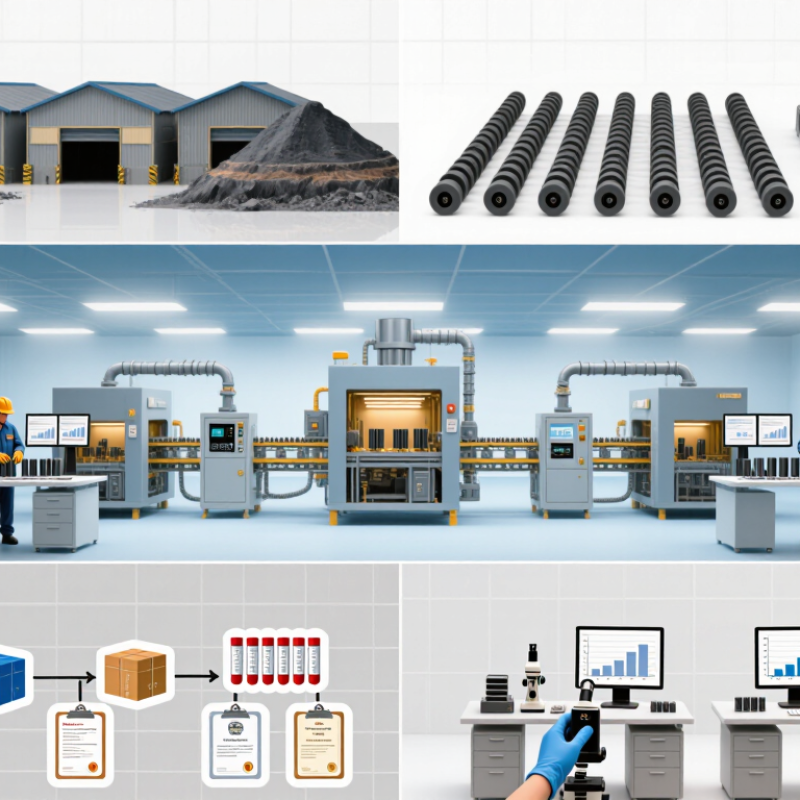
How to Choose Graphite Raw Material Suppliers in 2026

Define Your Graphite Raw Material Requirements

Before comparing suppliers, define what the graphite must do in your process. Battery anode, refractory, and lubricant applications need different particle sizes, purity levels, and physical properties. Write down natural or synthetic grade, particle-size distribution, fixed carbon, ash, moisture, sulfur, bulk density, and acceptable trace-element limits. Be specific about test methods and sampling. “High purity” alone is not a usable specification.

Match those limits to the end product and production steps. For example, a powder that meets carbon content requirements may still fail because its flakes are too coarse or its moisture disrupts processing.

The USGS Mineral Commodity Summaries 2025 estimates 2024 global natural graphite mine production at 1.6 million tonnes, up from 1.5 million tonnes in 2023. That supply figure describes mined natural graphite, not every processed grade available to buyers.

The IEA’s Global Critical Minerals Outlook 2024 also examines graphite supply chains and rising demand from clean-energy technologies, making grade-specific sourcing worth close attention.

Ask suppliers for recent certificates of analysis, lot-to-lot variation, test methods, and representative samples. Check whether their data match your own incoming-inspection procedure. A useful trial includes a small production run, not just a laboratory test.

Keep tolerances realistic; overly tight limits can narrow sourcing options without improving product performance. Our first specification is rarely perfect. Review it after testing, and record what changed.

Identify Supplier Types and Sourcing Regions

How to Choose Graphite Raw Material Suppliers in 2026

Supplier choice starts with knowing who handles the material. Mine operators sell natural graphite, while processors grade, purify, or shape it for specific uses. Synthetic graphite suppliers offer a different product, often made from petroleum-based feedstocks. Trading companies can simplify logistics, but add another handoff. Ask who controls quality at each step. Request recent certificates and a sample lot.

Region matters, but no sourcing map is risk-free. The U.S. Geological Survey’s 2025 Mineral Commodity Summaries estimated global natural graphite mine output at about 1.6 million tonnes in 2024. China produced roughly 1.27 million tonnes. The International Energy Agency’s 2024 outlook also describes graphite processing as highly concentrated in China. Brazil, Mozambique, Madagascar, and India offer alternative natural-graphite sources, though grades and shipping routes vary. A deposit’s location does not guarantee consistent product. Check where the material is processed, too.

Tips: Compare suppliers using the same test specifications, including particle size, ash, moisture, and carbon content. Ask for origin and processing records, then verify them against a trial shipment. A polished document can still miss batch variation. Test the actual material before committing to recurring volumes.

How to Choose Graphite Raw Material Suppliers in 2026

Identify supplier types and sourcing regions using natural graphite mine production as a regional sourcing indicator.

China led reported mine production in 2023, while Madagascar, Mozambique, Brazil, and India were other notable producing regions. When comparing suppliers, distinguish miners from processors and distributors, and verify product specifications, processing location, traceability, and current availability. Mine production is not the same as export volume or supplier capacity. Source: U.S. Geological Survey, Mineral Commodity Summaries 2024: Graphite; 2023 estimates.

Assess Material Quality, Specifications, and Traceability

How to Choose Graphite Raw Material Suppliers in 2026
Assess Material Quality, Specifications, and Traceability

A reliable supplier should provide a lot-specific certificate of analysis, not just a general product sheet. Check fixed carbon, ash, moisture, particle-size distribution, and bulk density against your process needs. Ask how samples are collected and whether test methods stay consistent between shipments. Small differences matter. A powder that looks uniform in a sample jar may behave differently in a production line.

Tips: Request a recent sample and compare its results with the shipment documents. Confirm acceptable tolerances in writing. Ask for records linking each lot to its processing site, inspection date, and test results. If answers are vague, pause and investigate.

Traceability is useful only when records are clear and verifiable. Review how the supplier identifies batches and handles changes in feedstock or processing. Where relevant, ask what origin and sourcing information can be documented, and how long records are retained. A polished certificate is reassuring, but it is not the whole picture. I would also check whether the supplier can explain an out-of-range result and describe corrective steps. Real processes are not perfect; honest, specific answers are more useful than promises of zero variation.

How to Choose Graphite Raw Material Suppliers in 2026 - Assess Material Quality, Specifications, and Traceability
Assessment Dimension What to Specify Evidence to Request Practical Acceptance Check
Material type and intended use Identify natural or synthetic graphite, product form, intended process, and application-specific requirements. Product specification, production route description, and a representative sample from the proposed product. Confirm the quoted material matches the required feedstock. Do not treat natural and synthetic graphite as interchangeable without application testing.
Carbon content and ash State whether the requirement is total carbon or fixed carbon, the reporting basis, units, test method, and lot limit. Lot-specific certificate of analysis (COA), test method, and laboratory identification. Compare results only when test methods and reporting bases are consistent. Set limits to match the end-use process rather than relying on a generic grade description.
Moisture and volatile matter Define maximum moisture and, where relevant, volatile matter, including the test conditions and reporting basis. Recent COA results and documented sampling and storage practices. Check that results are within the agreed limits and that packaging protects the material from moisture during storage and transport.
Particle-size distribution Specify the required size range or D10, D50, and D90, plus the measurement method and dispersion conditions where relevant. Lot-specific particle-size report and method details, such as sieve analysis or laser diffraction. Verify that the reported distribution—not only a nominal mesh or median size—fits the mixing, forming, or processing requirements.
Impurity profile Identify critical elements for the application and define limits in appropriate units, such as mg/kg or percent. Elemental analysis report, analytical method, detection limits, and the list of elements tested. Check that the reported detection limits are sufficiently low to assess the agreed limits. Request additional testing for application-critical contaminants.
Physical and functional properties Where relevant, specify bulk or tap density, specific surface area, particle morphology, or electrical properties. Test results tied to a stated method, sample preparation, and material lot. Include only properties that affect the application. Compare supplier results using equivalent methods and test conditions.
Lot consistency and sampling Define lot size, sampling plan, retention-sample requirements, and how out-of-specification results are handled. Written quality-control procedure, sample records, and trend data across multiple production lots. Review variation across lots, not just a single sample. Confirm that the buyer can inspect or independently test representative material.
Traceability and origin Require a traceable link from the delivered lot to its production site, source or feedstock category, and processing history. Lot identifiers, batch records, packing-list references, and documented chain-of-custody information. Check that identifiers agree across the COA, packaging, invoice, and shipping documents. Ask the supplier to explain any gaps in origin or processing records.
Quality management and change control Agree on notification requirements for changes to feedstock, processing, test methods, production site, or specification. Quality-system documentation, nonconformance procedure, and written change-control process. Confirm that changes affecting material properties require advance notice and, when needed, requalification before shipment.
Supplier qualification and incoming inspection Set a qualification plan, required documents, sample approval process, and risk-based incoming testing frequency. Pre-shipment sample, current COA, agreed specification, and corrective-action contact process. Approve the material against the buyer’s own requirements and verify selected lots through independent or incoming testing.
Specification note: Graphite properties and suitable limits depend on material type, production route, and end use. Treat values as buyer-defined requirements; agree on test methods, reporting basis, lot limits, and sampling before placing orders.

Compare Supplier Capacity, Compliance, and Logistics

How to Choose Graphite Raw Material Suppliers in 2026

Compare capacity using evidence, not a polished brochure. Ask for monthly production figures, available allocation, and recent delivery records. A supplier may quote ample annual output but have little stock during peak demand.

Request a representative sample and compare its particle size, moisture, and ash content with your specification. Small details matter.

Check whether quality documents identify the batch and match the material being offered.

Review compliance documents for completeness and current dates. Depending on the material and destination, request applicable safety data, certificates of analysis, and traceability records.

Confirm who performs testing and how changes to production are reported. A perfect forecast is rarely believable, and a document alone cannot prove consistent quality.

If a requirement is unclear, ask for written clarification before placing an order.

Tips:

Map the shipping route, estimated transit time, packaging, and unloading needs. Ask how delays, damaged bags, or missed sailings are handled. Compare the quoted delivery terms and check whether the supplier can share realistic lead times from recent shipments. One awkward question now can prevent an expensive surprise later.

Verify Supplier Reliability Through Samples and Audits

A polished datasheet does not prove a graphite supplier can deliver consistent material. The U.S. Geological Survey’s Mineral Commodity Summaries 2025 estimates global natural graphite mine production at 1.6 million metric tons in 2024, with about 1.27 million from China. That concentrated supply makes traceability and backup capacity worth checking. The International Energy Agency’s Global Critical Minerals Outlook 2024 also projects strong growth in clean-energy graphite demand through 2040. More demand can strain quality control. Ask for samples from multiple production lots, not one carefully selected bag.

Test each sample against your actual specifications. Check particle-size distribution, fixed carbon, moisture, ash, and impurities; record the method and instrument used. A useful audit follows the material from incoming feedstock through processing, packing, and shipment. Review calibration logs, batch records, change-control procedures, and rejected-lot data. Verify that the audited site is the site that will produce your order. Small details matter. A sample may pass while later batches drift. I would treat that gap as a real risk, not a paperwork issue. Repeat testing at an independent laboratory can expose differences, though it adds time and cost. Ask the supplier to explain any variation plainly. A hesitant answer can be more revealing than a perfect presentation.