
Choosing the best Freeze Dried Dog Food is not simply a matter of comparing protein percentages. Global buyers must examine safety controls, ingredient sourcing, nutrition, packaging, and destination-market compliance.
The American Pet Products Association reported $147 billion in U.S. pet industry sales in 2023. Its 2024 State of the Industry data also reflects continued spending on premium pet nutrition. Meanwhile, FEDIAF’s 2024 Facts & Figures report shows Europe’s substantial dog and cat population, confirming strong demand for specialized pet food. These figures suggest opportunity, but they do not prove that every premium product deserves trust.
Quality begins with traceability. Buyers should request batch testing, pathogen-control procedures, shelf-life evidence, and complete nutritional analysis. Freeze-drying can preserve texture and flavor, yet it does not automatically eliminate every biological risk. This distinction matters when products contain raw animal ingredients. The FDA and other national authorities regulate pet food differently, so import documents, labeling language, additive rules, and facility approvals require careful review.
Small details matter. A resealable pouch should protect food from humidity. A clear feeding guide should match a dog’s size, age, and activity level. Reliable suppliers should explain where meat comes from and how batches are tested.
There is no universal winner.
A product accepted in one market may face delays elsewhere. My own evaluation would prioritize verified safety over attractive packaging, although palatability and cost still influence real purchasing decisions. This guide compares practical evidence, not marketing promises, helping global buyers select Freeze Dried Dog Food with greater confidence and fewer costly assumptions.
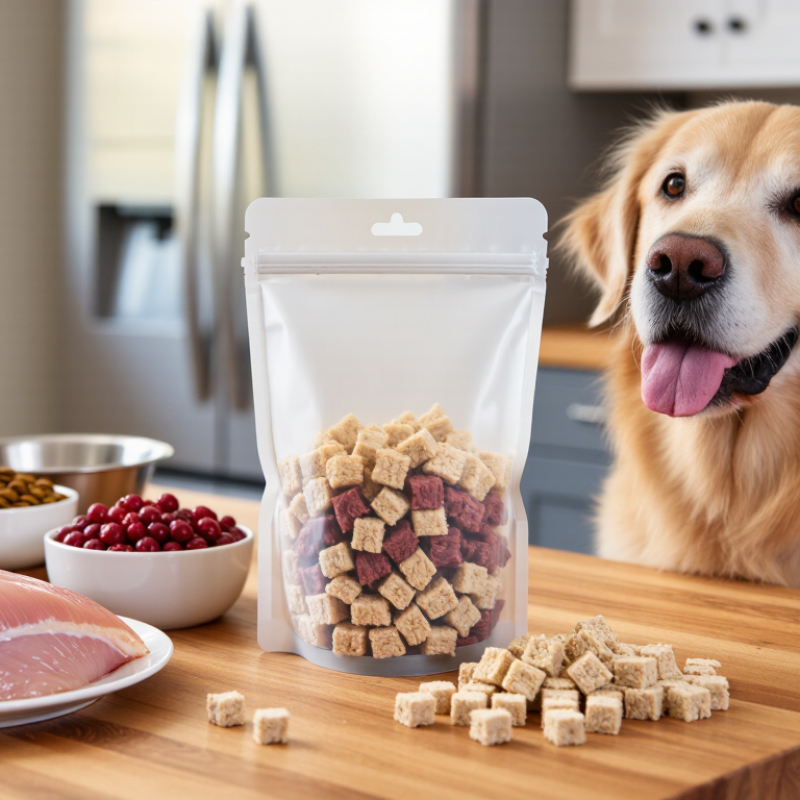
Freeze-dried dog food begins with raw or cooked ingredients, often meat, organs, vegetables, and supplements. Manufacturers blend these ingredients, portion the mixture, and freeze it rapidly. The frozen food enters a vacuum chamber. Ice changes directly into vapor, leaving a dry, porous structure. The result is lightweight and shelf-stable when packaged correctly. It also rehydrates quickly in a bowl. Grand View Research estimated the global freeze-dried pet food market at about USD 2.31 billion in 2023, showing strong interest in this format.
The process sounds simple. It is not. Water activity must be controlled carefully. FDA guidance warns that raw pet food can carry pathogens, including Salmonella and Listeria. Freeze-drying reduces moisture, but it does not reliably destroy every pathogen. That detail deserves more attention. Manufacturers should use validated sanitation, traceable suppliers, batch testing, and packaging that limits oxygen and moisture. Global buyers should also check local feeding standards, import rules, and storage requirements before purchasing.
Nutrition needs practical checking. Look for clearly named animal proteins, complete vitamin and mineral profiles, feeding directions, and a declared calorie value. AAFCO nutrient profiles can support evaluation in the United States, but other markets may use different standards. APPA reported that United States pet industry spending reached approximately USD 152 billion in 2024, reflecting continued demand for premium pet nutrition. Still, premium pricing does not prove superior nutrition. Rehydration ratios can vary, and some dogs may need a slower dietary transition. Careful labels matter more than attractive texture.
Compare nutrition on a dry-matter basis, not by the label’s guaranteed analysis alone. Freeze-dried food contains little moisture, yet serving sizes can vary widely. FEDIAF’s 2024 Nutritional Guidelines list minimum nutrient targets for adult dogs, including protein and fat requirements based on energy needs. AAFCO’s 2024 Official Publication also separates growth, reproduction, and adult-maintenance profiles. Therefore, buyers should match the formula with the dog’s life stage, size, activity, and health condition. “Complete and balanced” claims may follow different regional rules. Check the feeding standard and laboratory statement.
Ingredients deserve careful reading. Named animal proteins should appear clearly, not behind vague terms. Look for measured minerals, essential fatty acids, and declared calories per kilogram. A 2024 Pet Food Institute industry report highlights continuing consumer attention toward ingredient transparency and safety controls. However, attractive ingredient lists can mislead. More ingredients do not guarantee better nutrition. Freeze drying also does not automatically eliminate every microbial risk. Ask for batch testing, traceability, manufacturing location, and storage instructions. Quality evidence matters more than front-panel language.
Tips: Compare calories per gram, protein on a dry-matter basis, and feeding directions. Request a recent certificate of analysis when possible. Inspect the package for intact seals and a clear lot code. Transition gradually over seven days. I would not rely on appearance alone; even experienced buyers can overlook mineral balance or oxidation.
What Is the Best Freeze Dried Dog Food for Global Buyers?
For global buyers, the best freeze-dried dog food is not automatically the most expensive. It is the formula that matches a dog’s age, size, activity, and medical history. Puppies need carefully balanced calcium and phosphorus for developing bones. Large-breed puppies need stricter control. Adult working dogs may need more energy and protein. Older dogs often benefit from moderate calories and easily digestible proteins. Every dog differs.
Dogs with food sensitivities may do better with a limited-ingredient recipe. A single animal protein can make reactions easier to monitor, though it does not prove an allergy. Novel proteins may help some dogs, but veterinary guidance remains important. Dogs with kidney, liver, or urinary conditions need professional dietary advice. High protein is not automatically better. Check the guaranteed analysis, calorie content, added vitamins, and complete-and-balanced statement for the intended life stage. Regional standards can differ, so read the local label carefully.
In practice, I would rehydrate each meal with clean water, especially for dogs that drink little. Do not assume freeze-dried food is sterile. Handle it carefully, wash bowls, and follow storage instructions. Begin with small portions over seven to ten days. Loose stools can signal a rapid change, excess fat, or a poor match. The honest answer is sometimes inconvenient: a formula that looks ideal may not suit one dog. Observe stool quality, coat condition, appetite, and body weight for several weeks. Reassess with a veterinarian when results remain unclear.
The most suitable formula depends on the dog's life stage and dietary needs. The chart compares minimum crude protein and crude fat levels on a dry-matter basis, using the AAFCO Dog Food Nutrient Profiles as a practical reference point.
For adult dogs, choose a complete-and-balanced formula that meets adult-maintenance requirements. Puppies, pregnant dogs, and nursing dogs generally need the higher growth-and-reproduction benchmarks. Global buyers should compare guaranteed analysis on a dry-matter basis, check local regulatory standards, and confirm whether the freeze-dried food is complete and balanced rather than intended only as a topper.
Global buyers should inspect evidence, not just attractive freeze-dried claims. FEDIAF’s 2024 Facts and Figures report recorded 139 million pet-owning households in Europe. European pet food sales reached €29.3 billion in 2023. This scale increases product choice, but it does not guarantee safety. Freeze-drying removes moisture; it does not eliminate every microbial risk. Ask for documented pathogen controls, batch testing, and clear storage instructions. Not just marketing.
Check whether the food is complete and balanced for your dog’s life stage. Local standards may differ, so AAFCO and FEDIAF references are not automatically interchangeable. Compare protein and fat on a dry-matter basis, because moisture levels can distort labels. Request calories per kilogram, feeding directions, ingredient origins, lot codes, production dates, and best-before dates. Packaging should remain sealed, dry, and undamaged after long-distance transport. Import paperwork also matters. Customs delays can shorten practical shelf life.
The American Pet Products Association reported US pet industry spending of $147 billion in 2023, including $58.1 billion for food and treats. That demand encourages global expansion, sometimes faster than quality systems mature. Ask whether testing covers each batch or only periodic samples. A certificate of analysis helps, but it is not a complete guarantee. I would also request a traceability procedure and a realistic rehydration guide. One weakness in my checklist remains obvious: laboratory results may not reflect every package. The box may look perfect. Content still deserves scrutiny.
| Check Dimension | What Global Buyers Should Verify | Useful Data Point or Benchmark | Why It Matters | Recommended Evidence Before Ordering |
|---|---|---|---|---|
| Complete and Balanced Status | Confirm whether the product is intended as a complete diet or only as a topper, treat, or supplemental food. | The label should clearly identify the intended life stage and nutritional purpose. | A food that is not complete and balanced may not meet a dog’s daily nutritional requirements when fed as the main diet. | Obtain the full label, nutritional adequacy statement, and feeding instructions for the destination market. |
| Life-Stage Suitability | Check whether the formula is designed for adult maintenance, growth, reproduction, or all life stages. | Puppy and reproduction formulas generally require higher nutrient specifications than adult-maintenance formulas. | Feeding requirements differ substantially according to age, body size, pregnancy, and activity level. | Request a life-stage declaration and a nutrient profile appropriate to the target dog population. |
| Protein Content | Review crude protein on a dry-matter basis rather than comparing only the guaranteed-analysis percentage. | Many freeze-dried complete diets fall within approximately 30–50% crude protein on a dry-matter basis, but the suitable level depends on the dog and formula. | Freeze-drying removes water, so “as-fed” and dry-matter values can look substantially different. | Ask for the guaranteed analysis, moisture level, and laboratory certificate of analysis. |
| Fat Content | Check crude fat, fatty-acid sources, and whether the formula is appropriate for dogs needing controlled fat intake. | A typical freeze-dried diet may contain approximately 15–30% crude fat on a dry-matter basis. | Fat strongly affects calorie density and may be important for highly active dogs or dogs requiring dietary management. | Request fat analysis, calorie content, and a complete ingredient specification. |
| Moisture Level | Confirm the moisture percentage before comparing nutritional values or calculating freight weight. | Freeze-dried products commonly contain about 2–10% moisture, although the actual value is product-specific. | Lower moisture improves storage efficiency but makes the food calorie-dense and unsuitable for direct comparison with wet food by weight. | Verify the guaranteed moisture maximum and the laboratory testing method. |
| Calorie Density | Check metabolizable energy per 100 grams and per cup or serving after rehydration. | Many freeze-dried diets provide roughly 350–550 kcal per 100 g as fed; the exact value must come from the supplier. | High calorie density can reduce shipping volume but increases the risk of overfeeding if portions are estimated incorrectly. | Request an official kcal/kg or kcal/100 g declaration and feeding calculations for different dog weights. |
| Calcium and Phosphorus | Review calcium, phosphorus, and the calcium-to-phosphorus relationship for the intended life stage. | A calcium-to-phosphorus ratio close to 1:1–2:1 is commonly used as a practical reference, subject to applicable nutritional standards. | Mineral balance is especially important for puppies, large-breed dogs, and breeding animals. | Request a complete mineral analysis on a dry-matter basis and confirmation of the applicable standard. |
| Ingredient Transparency | Check the exact animal species, plant ingredients, oils, additives, preservatives, and potential allergens. | Ingredients should be listed in descending order by weight before processing, according to the relevant labeling rules. | Clear ingredient information helps buyers manage allergies, dietary restrictions, and market-specific labeling requirements. | Obtain the final commercial label, ingredient specification, and allergen declaration. |
| Animal-Ingredient Traceability | Verify the origin and traceability of meat, fish, poultry, and organ ingredients. | A credible supply chain should trace key animal ingredients back to approved suppliers and production lots. | Traceability supports recalls, import clearance, food-safety investigations, and buyer confidence. | Request supplier declarations, lot codes, country-of-origin information, and traceability procedures. |
| Pathogen Control | Ask how the manufacturer controls Salmonella, Listeria, pathogenic Escherichia coli, and other relevant hazards. | A freeze-drying step reduces water activity but should not be treated as a substitute for validated pathogen-control procedures. | Low moisture does not automatically guarantee microbiological safety, particularly after rehydration or handling. | Request hazard-analysis documentation, environmental-monitoring information, and recent batch test results. |
| Water Activity | Check water activity rather than relying only on moisture percentage. | A water activity below approximately 0.60 generally prevents the growth of most bacteria, yeasts, and molds, but product stability must still be validated. | Water activity is a key indicator of shelf stability and resistance to microbial growth. | Request water-activity results for finished-product batches and the specified testing method. |
| Shelf Life | Confirm the unopened shelf life, minimum remaining shelf life at shipment, and storage conditions. | Shelf life is commonly stated in months and must be supported by stability data rather than assumed from low moisture alone. | Long international transit times, customs delays, and hot climates can reduce the usable shelf life. | Request stability-test summaries, expiry-date rules, and a minimum remaining shelf-life commitment. |
| Packaging Performance | Evaluate oxygen, moisture, light, puncture, and seal protection for long-distance transport. | Resealable, high-barrier packaging with a reliable heat seal is generally preferable for low-moisture products. | Oxygen and moisture exposure can cause rancidity, texture changes, mold growth, and nutrient degradation. | Request packaging specifications, seal-integrity testing, carton dimensions, and pallet configuration. |
| Rehydration Instructions | Check the recommended water quantity, soaking time, serving temperature, and storage time after rehydration. | Water ratios vary by formula; the instructions should provide a measured ratio rather than only general wording. | Accurate rehydration supports hydration, portion control, palatability, and safe handling. | Request validated preparation instructions and a serving guide for different dog weights. |
| Export and Import Documents | Determine which documents are required by the destination country before placing the order. | Common documents may include a commercial invoice, packing list, certificate of origin, health certificate, product specification, and transport documents. | Missing documentation can cause customs delays, additional costs, rejection, or destruction of the shipment. | Obtain a destination-specific document checklist from the importer or competent authority. |
| Label Compliance | Check language, units, ingredient naming, net quantity, feeding directions, batch identification, and importer details. | Labels should comply with the regulations of every intended sales market, not only the manufacturing country. | One label may not be legally acceptable in multiple countries because labeling and claims rules differ. | Request editable label artwork and conduct a destination-market compliance review before printing. |
| Claims and Marketing Language | Review claims such as “natural,” “human-grade,” “hypoallergenic,” “grain-free,” or “raw-inspired.” | Claims should be supported by objective evidence and permitted under the destination market’s rules. | Unsubstantiated or restricted claims can create regulatory, customs, and advertising risks. | Request claim-support documents, definitions, and approval from the importer’s regulatory adviser. |
| Order and Logistics Data | Confirm minimum order quantity, production lead time, carton size, gross weight, pallet volume, and temperature requirements. | Freeze-dried food is lightweight relative to wet food but often has high value per kilogram and requires moisture protection. | Accurate logistics data is essential for landed-cost calculations and warehouse planning. | Request a current quotation showing EXW, FOB, CIF, or DDP terms, as applicable. |
| Batch Consistency | Check whether nutrient values, texture, color, and piece size remain consistent between production lots. | Each lot should have a unique batch code and quality-release records. | Consistent batches reduce customer complaints and simplify recalls or market withdrawals. | Request recent certificates of analysis from multiple lots and the batch-release procedure. |
| Total Landed Cost | Calculate product price, freight, insurance, duties, taxes, customs brokerage, testing, relabeling, warehousing, and waste. | The final landed cost should be calculated per kilogram and per daily feeding portion, not only per case. | A low purchase price can become uncompetitive after freight, import charges, and compliance costs. | Prepare a landed-cost worksheet using confirmed shipment weight, volume, tariff classification, and destination charges. |
| Buyer Risk Level | Assess the supplier’s documentation quality, response time, production capacity, recall procedure, and insurance coverage. | Verify before payment | Reliable documentation and traceability are practical indicators of export readiness and operational control. | Use a pre-shipment inspection, written quality agreement, approved sample, and clearly defined non-conformance process. |
Freeze-dried dog food travels well, but storage still decides its safety and texture. FEDIAF’s 2024 European Pet Food Facts and Figures report lists 139.7 million pet-owning households in Europe. Global buyers therefore need instructions that survive different climates. Keep unopened packs sealed in a cool, dry cupboard. Avoid sunlight, bathrooms, garages, and humid kitchens. After opening, press out excess air and use a clean, dry scoop. Reseal the package tightly. A moisture absorber helps, but it cannot repair poor storage.
Rehydrate only the portion your dog will eat. Use clean drinking water at room temperature, then follow the food’s stated ratio. The popular one-to-one rule is convenient, but it is not universal. Some recipes need more water. Stir thoroughly and wait several minutes for the pieces to soften. Check the center before serving. It should feel moist, not crunchy. Wash the bowl after every meal. Do not leave rehydrated food at room temperature for long; a cautious two-hour limit is sensible, especially in warm rooms.
APPA’s 2023–2024 National Pet Owners Survey reports that 66% of U.S. households own a pet, increasing demand for practical feeding guidance. In my experience, owners often prepare too much and refrigerate it without labeling. Mark the container with the preparation time. Refrigerate leftovers promptly, and use them according to the manufacturer’s stated window. When uncertain, discard them. Waste feels frustrating. Food safety matters more. Check for sour odors, slimy texture, swelling, or unusual color before serving.